 Anchor
How to Use a Crypto Safe: 3 Addresses and Three Levels of Protection
If this is your first time dealing with a crypto safe, it can seem more complicated than it really is. In practice, the main thing is to set up three addresses properly and pick the right level of protection.
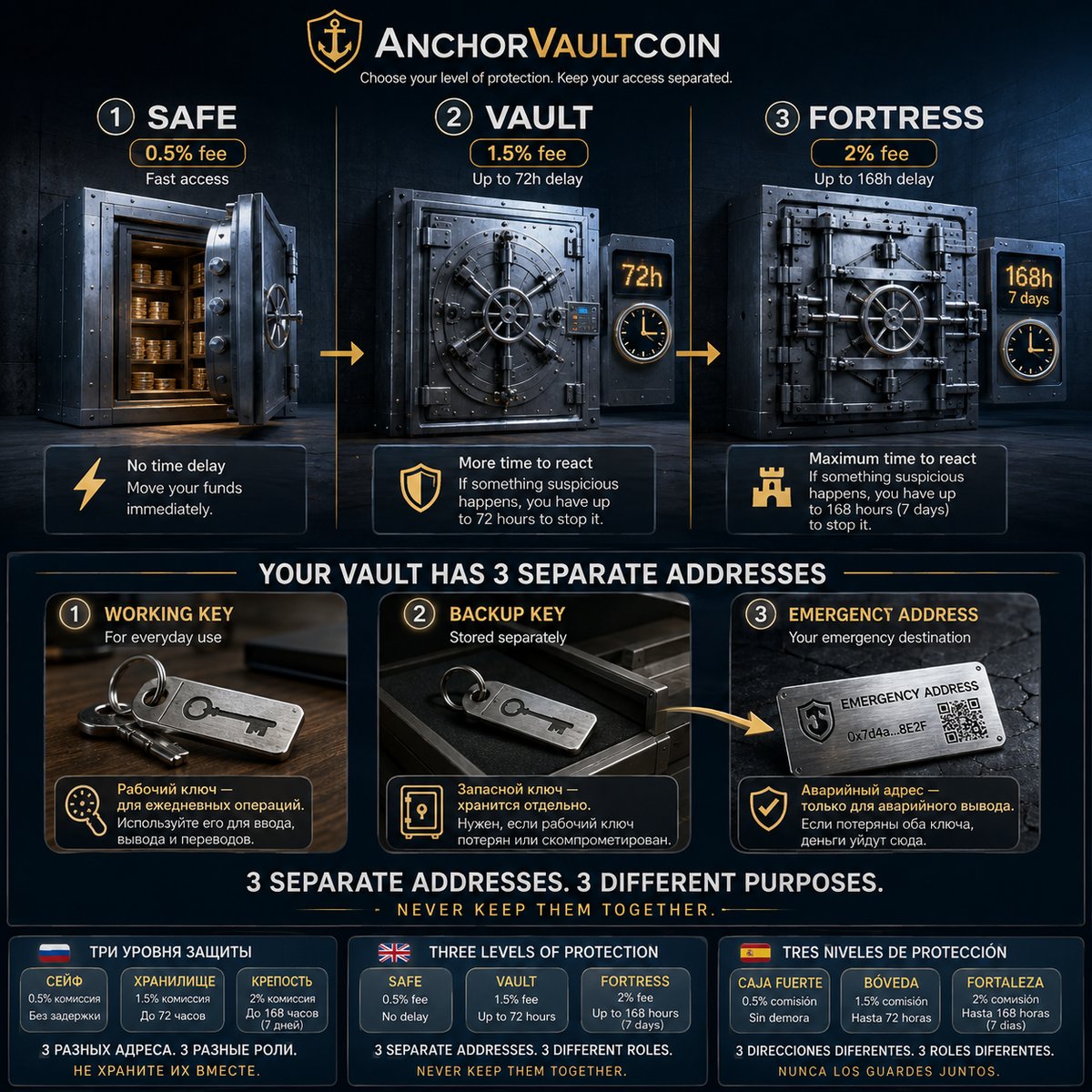 3 keys, 3 safes — how to use them?
First — three different addresses
A single safe requires three different addresses.
1. Working key
This is your main wallet for everyday use. You’ll use it to perform regular operations with the safe.
2. Backup key
This is for the case something happens to your working key — for example, you lose access to it. The backup key should be stored separately from the working key.
3. Emergency address
This is the address for a worst-case scenario — if you lose access to both keys at once. It’s not used for everyday operations. Its job is to receive funds when normal access to the safe is no longer possible.
The most important rule: all three addresses must be different.
Don’t use the same wallet as your working key, backup key, and emergency address all at once. The whole point of separating them is that losing or compromising one address doesn’t create a problem for all three roles at the same time.
Now choose your safe level
AnchorVaultCoin has three levels. They differ in cost and in how long a time delay you can set before an operation.
SAFE
The simplest option.
Fee — 0.5%.
No additional time delay. If you don’t need extra time to review operations and want to access your funds without a delay, this level works for you.
VAULT
The middle option.
Fee — 1.5%.
You can set a delay of up to 72 hours, or three days.
Why have a delay? It gives you extra time to notice a suspicious operation. If you see something you didn’t authorize, you have more time to react before the operation goes through.
FORTRESS
The highest of the three levels.
Fee — 2%.
The delay can be up to 168 hours — seven days.
This is for those who care more about maximum reaction time than speed of operations.
Which one should you pick?
There’s no one-size-fits-all answer here.
If simplicity and speed matter most — go with SAFE.
If you want extra time to review operations — go with VAULT.
If you’re willing to wait longer for the longest possible time-based protection — go with FORTRESS.
The logic is simple: the more time that passes before an operation is finalized, the more time the owner has to spot a problem and react.
Key takeaways
Before creating a safe, take your time.
Prepare three different addresses:
Working key → Backup key → Emergency address.
Store them separately and don’t combine multiple roles in a single wallet.
Then pick the level that fits how you want to store your funds: SAFE, VAULT, or FORTRESS.
The point of the whole system isn’t to make crypto management more complicated. It’s the opposite — separate your everyday access, backup option, and emergency exit in advance, then decide how much time you want to have to react to a suspicious operation.